
How much do influencers charge in 2026? As a baseline, a nano creator (1K–10K followers) typically charges $100–500 per Instagram post and $200–1,000 per TikTok video, micro creators (10K–50K) sit around $500–5,000, and anyone above 500K followers starts at roughly $10,000 per deliverable, according to Influencer Marketing Hub’s rate tracker. Those ranges are wide on purpose: platform, format, usage rights, exclusivity and audience quality can double or halve a quote. This rate card breaks the numbers down by platform and tier, then shows how to sanity-check a price before you sign.
Key takeaways
- Per-post rates scale with tier: roughly $100–1,500 for nano, $500–5,000 for micro and $10,000+ for macro and mega creators, depending on platform.
- TikTok and YouTube usually price above Instagram at the nano level; X is by far the cheapest platform per post.
- About 55% of nano and micro deals and roughly 80% of UGC deals close under $500 (Influencer Marketing Hub, 2026).
- Usage rights, paid-ad whitelisting and exclusivity are priced on top of the base fee, never assumed.
- Adjust every quote for audience quality: up to 48% of followers in some tiers show signs of being inauthentic.
How much do influencers charge per post? The 2026 rate card
The table below consolidates the per-post ranges published by Influencer Marketing Hub (last updated July 2026). Treat them as market reference points, not price tags. Individual quotes vary with niche, engagement and deliverable, and top creators in each tier can charge well above the upper bound.
| Tier (followers) | TikTok | YouTube | X (Twitter) | |
|---|---|---|---|---|
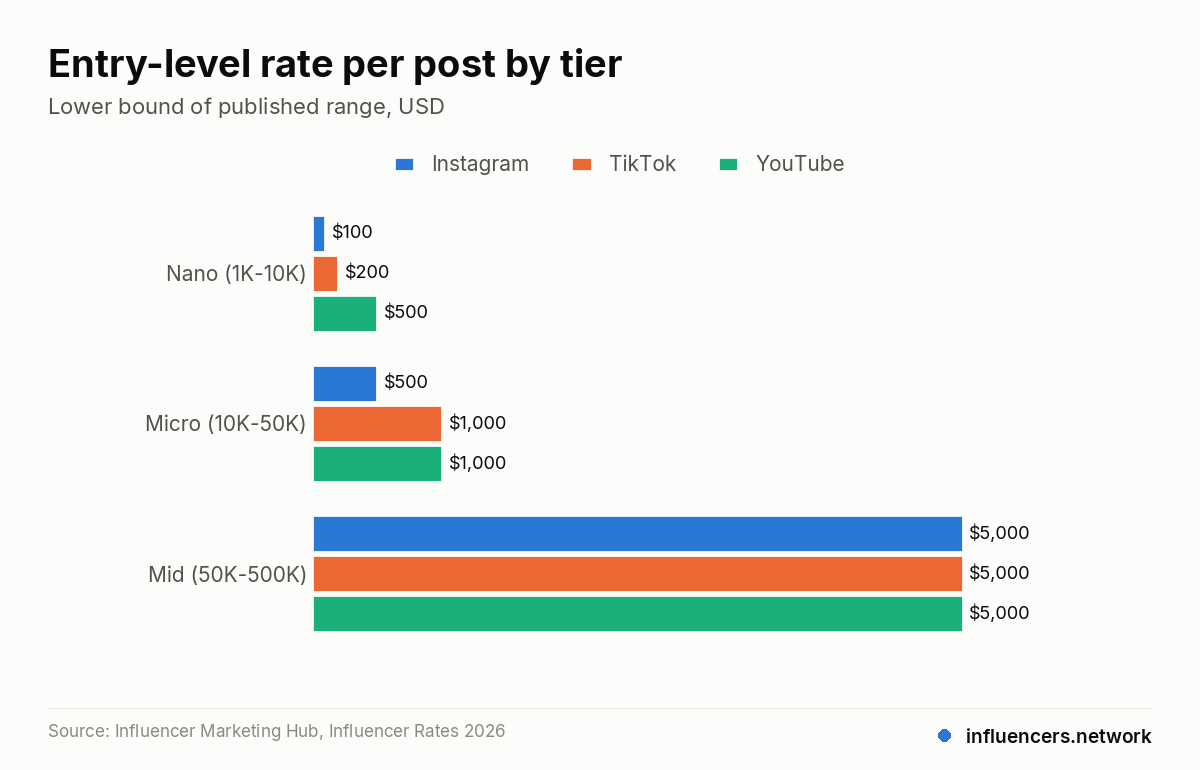
| Nano (1K–10K) | $100–500 | $200–1,000 | $500–1,500 | $2–100 |
| Micro (10K–50K) | $500–5,000 | $1,000–5,000 | $1,000–5,000 | $100–500 |
| Mid-tier (50K–500K) | $5,000+ | $5,000–10,000 | $5,000–10,000 | $500–1,000 |
| Macro (500K–1M) | $5,000–10,000+ | $10,000+ | $10,000+ | $1,000–5,000 |
| Mega (1M+) | $10,000+ | $10,000+ | $10,000+ | $5,000+ |
Two patterns stand out. First, video platforms carry a premium at the bottom of the market: a nano YouTuber’s floor ($500) is five times a nano Instagrammer’s ($100), because a produced video takes far more work than a static post. Second, text-first X is an order of magnitude cheaper across every tier, which reflects lower production effort and lower perceived ad value.
Where most deals actually land
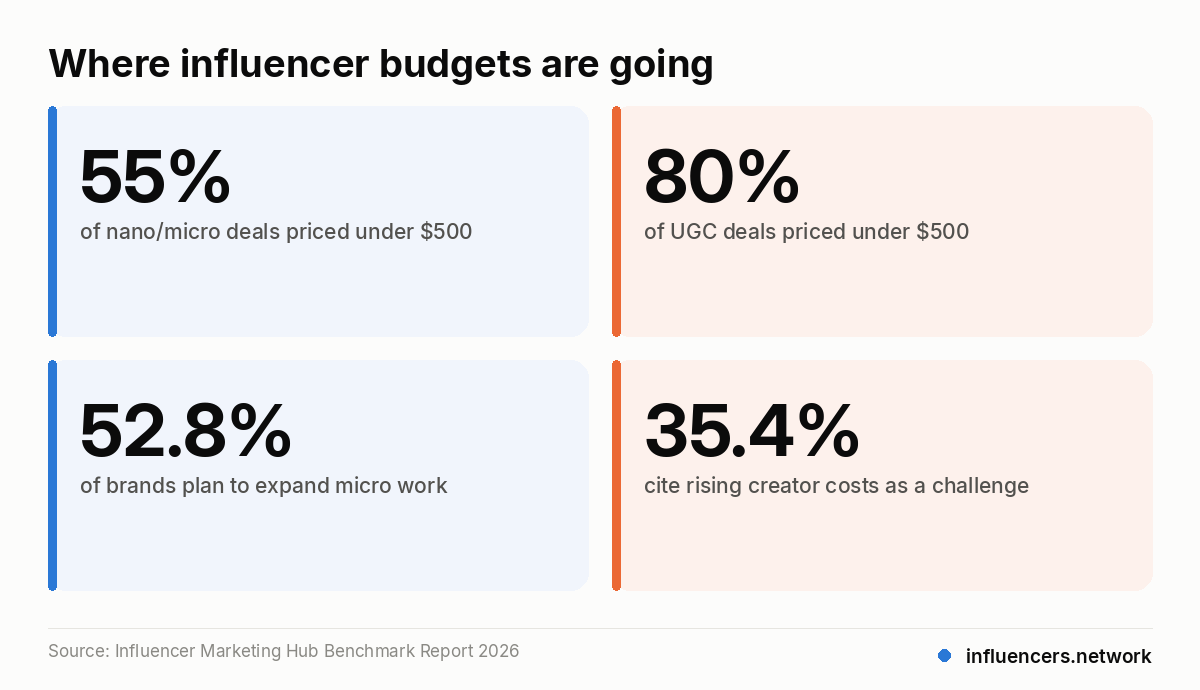
“How much do influencers charge?” is only half the question; the other half is what brands actually end up paying. Headline ranges hide how skewed real spending is toward small creators. In the Influencer Marketing Hub Benchmark Report 2026 (600+ respondents), around 55% of nano and micro partnerships were priced under $500, and about 80% of UGC deals came in under the same mark.
Demand is also shifting down-market. 52.83% of brands plan to expand micro-influencer work and 51.43% nano, versus only 20.59% for macro creators. At the same time, 35.4% of respondents named rising creator costs as a top challenge, so the cheapest tiers are getting more competitive. For the wider picture, see our roundup of influencer marketing statistics for 2026.
The three pricing models behind a quote
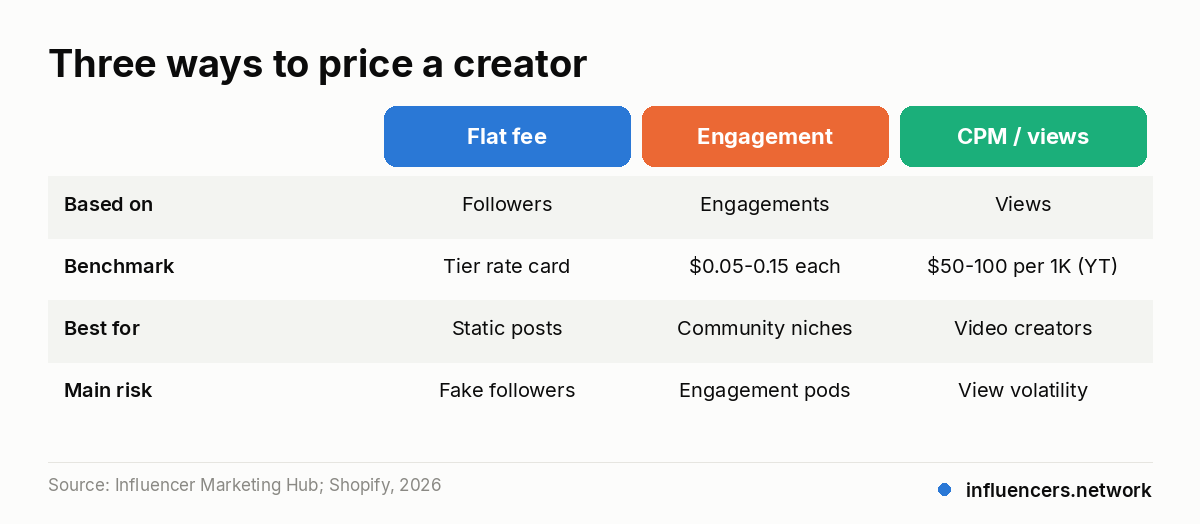
Creators rarely pull a number from thin air. Most quotes are built on one of three formulas, and knowing them helps both sides negotiate from the same logic.
1. Follower-based flat fee
The simplest model: a fixed fee per deliverable tied to audience size, which is what the rate card above describes. It is easy to budget but rewards follower counts rather than results, which is risky when fake followers are common (more on that below).
2. Engagement-based pricing
Shopify’s 2026 pricing guide uses the formula followers × engagement rate × rate per engagement, with rate-per-engagement typically 10–15 cents in beauty and fashion and 5–8 cents in general lifestyle. Its worked example: a 50,000-follower creator with 3% engagement at $0.10 per engagement gives a $150 base, and usage rights, exclusivity and a rush fee lift the total to $325 (Shopify).
3. CPM or view-based pricing
Video creators increasingly price on views. Influencer Marketing Hub cites $50–100 per 1,000 views as an alternative YouTube benchmark. A creator whose sponsored integrations average 40,000 views would therefore land around $2,000–4,000 per video. Shopify’s example applies a $10–20 CPM to beauty content on TikTok: 100,000 views at $15 CPM equals $1,500.
Add-ons that change the price
The base fee usually covers creation plus one organic post on the creator’s own channel. Everything else is negotiated separately, and it is where budgets most often blow out.
- Usage rights. Reposting on brand channels, running the content as a paid ad or using it on a website costs extra. Perpetual, unlimited usage carries the highest premium (Shopify). Always define channels and duration in writing.
- Whitelisting or Spark Ads. Running ads through the creator’s handle is a form of usage right and should be scoped by duration and spend.
- Exclusivity. Blocking competitors raises the price “quite a bit,” per Influencer Marketing Hub. Shopify notes campaign exclusivity windows of two to seven days are common; category-wide or multi-month exclusivity costs much more.
- Format and effort. Long-form video, scripted integrations and live streams cost more than static posts or Stories.
- Timing. Peak seasons such as holidays or major sporting events carry a premium, and rush turnarounds typically add a fee.
- Agency margin. If a talent manager or agency is involved, their fee sits on top of the creator’s rate.
Adjust every quote for fake followers
A follower-based quote is only fair if the followers are real. The SociaVault Fake Follower Study 2026, which analyzed 100,000 Instagram and TikTok accounts, found that 37.2% of followers show signs of being inauthentic, rising from 27.6% among nano accounts to 48.3% in the 100K–500K band. Instagram (41.8%) scored worse than TikTok (32.6%).
Here is what that means for price. The example below is illustrative: it applies SociaVault’s tier averages to hypothetical quotes that sit inside the Influencer Marketing Hub ranges.
| Illustrative creator | Quote | Nominal cost per 1K followers | Avg. inauthentic share (tier) | Cost per 1K authentic followers |
|---|---|---|---|---|
| Nano, 8,000 followers | $300 | $37.50 | 27.6% | $51.80 |
| Micro, 40,000 followers | $2,000 | $50.00 | 34.9% | $76.80 |
| Mid, 80,000 followers | $5,000 | $62.50 | 41.3% | $106.50 |
The practical rule: ask for audience analytics (screenshots or a read-only insights link), check comment quality, and price on authentic reach or views where you can. SociaVault found comment-quality analysis was the most accurate single fraud signal in its study.
What casino and betting creators charge
iGaming pricing follows different logic because most deals are performance-linked and restricted to licensed markets. Streamers are usually paid through CPA, RevShare, a hybrid of both, or a minimum guaranteed fee (MGF). The Parimatch Affiliates 2026 guide puts MGFs at $1,000–4,000 per month for streamers with a 15–20K audience and recommends keeping 20–30% of budget on RevShare to limit downside.
Rates also depend on what a creator is legally allowed to do. Ontario bars influencers likely to appeal to minors from igaming ads, Germany allows only GGL-whitelisted operators to advertise, and Brazil’s Senate is debating a sweeping ad ban. A creator whose audience sits in restricted markets is worth less to a licensed operator, whatever the follower count. Our explainer on how casino streamer deals work covers each model in detail.
How to price a deal in five steps
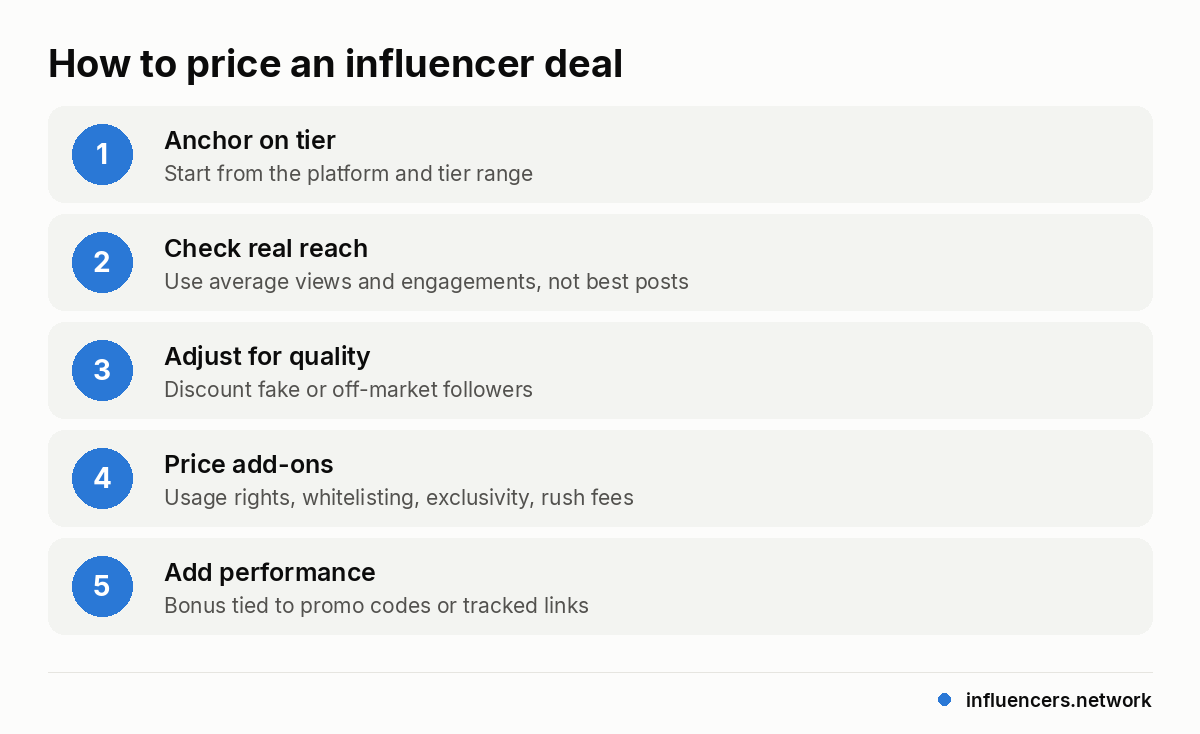
- Anchor on the market range for the creator’s tier and platform using the rate card above.
- Cross-check with engagement or CPM using average views or engagements from the last 10–15 posts, not the best-performing one.
- Discount for audience quality and geography: followers outside your target markets add little value.
- Price add-ons explicitly: usage rights, whitelisting, exclusivity and rush fees as separate line items.
- Tie part of the fee to results with promo codes or tracked links. Promo codes (45.9%) and affiliate links (26.0%) are the most common measurement methods in the 2026 benchmark.
For creators wondering how much influencers charge at their own size, the same steps work in reverse: publish a rate card with base prices per format and a clear add-on menu, and back it with current analytics. Our post on how much Instagram pays for 1,000 views explains why brand deals, not platform payouts, drive most creator income.
Creator-educator Roberto Blake walks through how creators can set rates for sponsored content and brand deals in this video.
Disclosure is part of the price
Every paid post must be clearly labeled. In the US, the FTC’s Endorsement Guides (revised 2023) require clear and conspicuous disclosure (see the FTC’s Disclosures 101 for Social Media Influencers), and the UK requires #ad labeling under ASA and CMA guidance. Budget for compliance review, especially in gambling, where ads featuring people of strong appeal to under-18s are banned in the UK.
18+ | Play responsibly. Gambling involves risk and should never be seen as a way to make money. Only work with operators licensed in the viewer’s jurisdiction. Help: BeGambleAware, NCPG (1-800-GAMBLER), JugarBien.
Frequently asked questions
How much does an influencer with 10,000 followers charge?
A creator at the nano/micro boundary typically charges somewhere around $100–500 per Instagram post or $200–1,000 per TikTok video, per Influencer Marketing Hub. Engagement, niche and add-ons such as usage rights can move the price outside that range.
Is TikTok more expensive than Instagram?
At the nano level, TikTok’s published range ($200–1,000) starts higher than Instagram’s ($100–500). From micro upward the two converge, and at the mega tier both start around $10,000 per post.
Should I pay per post or per view?
Per-view (CPM) pricing ties cost to actual reach and suits video creators with stable view counts. Flat fees are simpler for one-off posts. Many brands combine a modest flat fee with a performance bonus tied to views, codes or tracked links.
Are usage rights included in an influencer’s rate?
Usually not. The base rate normally covers organic posting on the creator’s channel. Reposting, paid ads, whitelisting and exclusivity are negotiated as extras, with duration and channels specified in the contract.
Brands can compare creators by tier, platform and market in the influencers.network influencer database. Creators can list a profile for free and let brands find them.
Comentarios