
Kick vs Twitch gambling comes down to one difference: Kick permits slots and casino streams from licensed, identity-verified (KYC) sites, while Twitch has banned streaming of unlicensed slots, roulette and dice sites since October 2022 and still allows sports betting, poker and fantasy sports. YouTube sits in between: it lets creators show gambling from Google-certified operators, but age-restricts online casino content and removes anything that points viewers to uncertified sites. Below is a side-by-side breakdown of the rules as of September 2026, what each one means for operators and affiliates, and how to brief creators so a campaign doesn’t get pulled mid-flight.
Key takeaways
- Twitch: no streaming of slots, roulette or dice sites that lack a US or equivalent license (effective 18 Oct 2022); links and referral codes to any site offering those games are prohibited. Sports betting and poker remain allowed.
- Kick: casino streaming is allowed, but since 1 Feb 2025 only from sites that verify player identity (KYC). Sponsored gambling must be for platforms licensed in the relevant jurisdiction.
- YouTube: since 19 Mar 2025, no links, logos or verbal references to gambling sites not certified by Google; online casino content is age-restricted even when the operator is certified.
- Platform rules are a floor, not a ceiling. National ad law (Ontario, Germany, Spain, Brazil, UK) applies on top of them.
Kick vs Twitch gambling rules at a glance
The three platforms regulate different things. Twitch regulates which game types can be shown from unlicensed sites. Kick regulates which sites can be shown, using KYC as the filter. YouTube regulates which operators can be referenced at all, using Google’s own certification program, and then limits who can watch through age restrictions.
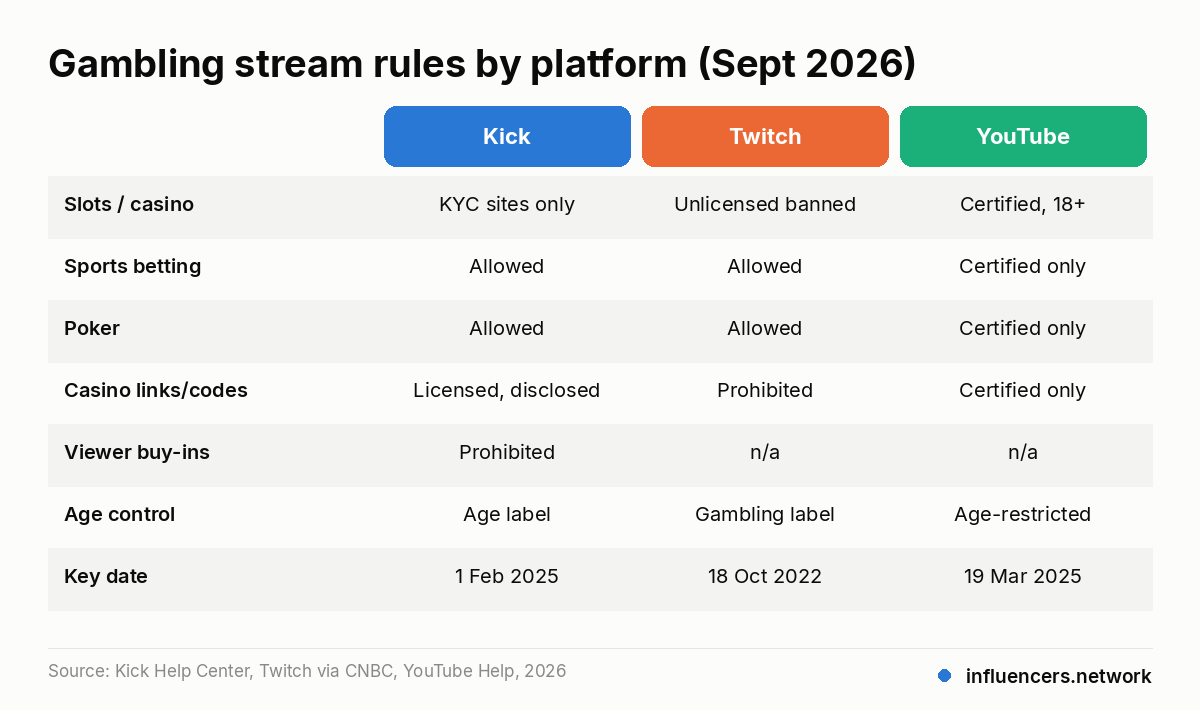
The table below expands on the comparison card with the details that matter when you negotiate a deal or write a creator brief.
| Rule area | Kick | Twitch | YouTube |
|---|---|---|---|
| Slots, roulette, dice streams | Allowed from KYC-verified sites | Banned from sites without US or equivalent license | Allowed from Google-certified operators; age-restricted |
| Sports betting and poker | Allowed | Allowed | Allowed from certified providers; some live-sport content may be shown to all audiences |
| Links and referral codes | Allowed for licensed sponsors; must be disclosed | Prohibited for any site offering slots, roulette or dice | Prohibited for uncertified sites (links, logos, verbal mentions) |
| Viewer-funded gambling | Prohibited (“no buy-ins from your audience”) | Not separately specified | Not addressed separately; guaranteed-return claims banned |
| Audience protection | Age labels; minors must never participate | “Gambling” content classification label | Age restriction: no under-18s or signed-out viewers |
| Key effective date | 1 Feb 2025 (KYC rule) | 18 Oct 2022 | 19 Mar 2025, expanded 17 Nov 2025 |
Twitch: the 2022 ban on unlicensed slots, roulette and dice
Twitch announced the change in September 2022 after a wave of criticism from top streamers, and it took effect on 18 October 2022. The policy prohibits streaming slots, roulette and dice games from sites that are not licensed in the US or in other jurisdictions that provide sufficient consumer protection. Twitch named Stake.com, Rollbit, Duelbits and Roobet as examples of sites covered.
The ban is narrower than many people assume. Sports betting, fantasy sports and poker were explicitly left out of scope. Twitch also already prohibited sharing links or referral codes to any site that includes slots, roulette or dice, and said at the time that it had seen people circumvent those rules, as CNBC reported. In practice, that makes casino sponsorship on Twitch very hard to structure even with a licensed operator.
In June 2023 Twitch added content classification labels, including a dedicated “Gambling” label. UK regulator Ofcom later found that labeling of gambling streams became noticeably more accurate after the change, with only 65% of gambling streams correctly labeled as mature before it.
The video below, from a streaming-news channel, recaps the announcement and the creator reaction at the time.
What still works on Twitch for iGaming brands
- Sports betting content and watch-alongs with licensed sportsbooks, subject to local ad law.
- Poker streams, which remain a large and relatively low-risk category for brand safety.
- Awareness activity that does not involve streaming restricted casino games or sharing casino referral codes.
Kick: casino-friendly, with a KYC filter
Kick has taken the opposite approach. Gambling is one of its biggest categories, and the platform is backed by founders linked to Stake. Rather than banning game types, Kick announced in late 2024 that from 1 February 2025 creators could only stream gambling from sites that verify users’ identity, a change industry outlet CasinoBeats described as a step to keep minors off gambling sites promoted on the platform.
Kick’s current community guidelines add several creator obligations that brands should mirror in their contracts:
- Follow the gambling laws of your own jurisdiction.
- Do not gamble with funds provided by viewers (no audience buy-ins).
- Minors must never take part in gambling activity, and gambling streams must carry the proper age label.
- Sponsored gambling is permitted only for platforms licensed in the relevant jurisdiction.
- Affiliate links must be disclosed clearly, next to the link or audibly on stream.
Note the phrase “licensed in the relevant jurisdiction”. KYC alone is Kick’s condition to stream a site; a sponsorship must also be legal where the audience is. A KYC-compliant offshore casino is still off-limits for a campaign aimed at Ontario, Germany or Brazil, where only locally licensed operators may advertise.
YouTube: certification first, then age restriction
YouTube tightened its rules on 19 March 2025. Creators may no longer include links, images, logos or verbal references to gambling sites or apps that have not been certified by Google or reviewed by YouTube, and content promising guaranteed returns is removed even if the operator is certified, Yogonet reported. At the same time YouTube began age-restricting content that promotes online casinos, so it cannot be seen by signed-out users or anyone under 18.
A second update took effect on 17 November 2025. According to SBC Americas, it extended the policy to gambling involving digital goods such as video game skins and NFTs and brought social casino content under the certification requirement. YouTube’s regulated goods policy now lists online gambling and social or sweepstakes casinos among content that is age-restricted, including content from certified sites.
The practical effect: YouTube is workable for licensed operators with Google certification in the target country, but reach is capped by the age gate. Sports betting from certified providers is treated more leniently, and YouTube notes some live-sport betting promotion may be shown to all audiences where local rules allow.
Where the audience actually is
Policy only matters in proportion to reach. Twitch is still the largest live platform by hours watched, but Kick is growing much faster and concentrates casino viewing. Stream Hatchet and Streams Charts data compiled by Tech Insider put 2025 hours watched at 19.2 billion for Twitch (down 10% year on year), an estimated 21 billion for YouTube Gaming and 4.5 billion for Kick (up 131%).
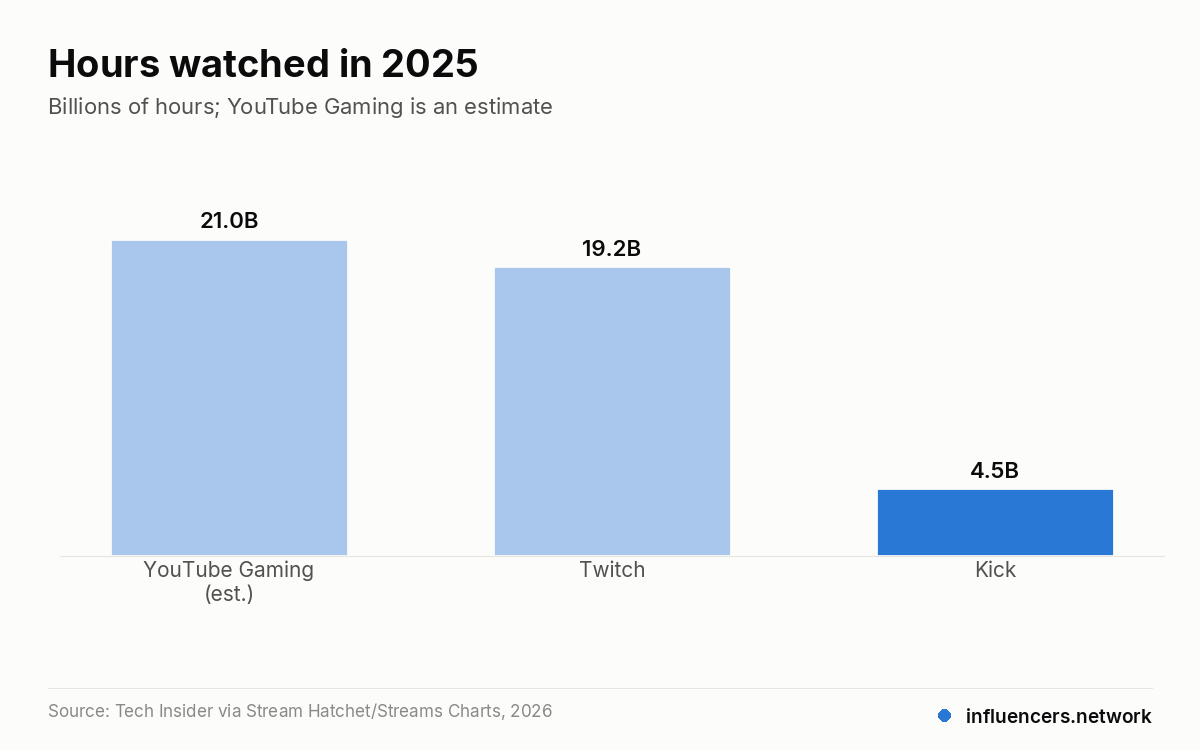
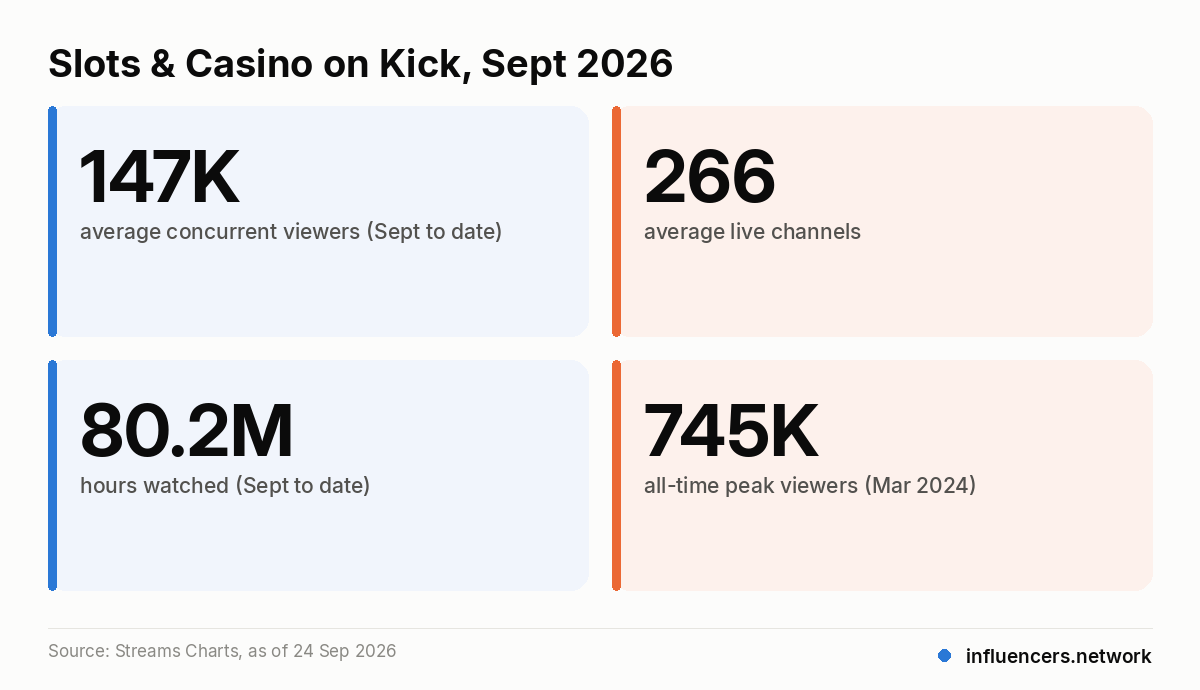
Casino content punches far above its weight on Kick. Streams Charts shows the Slots & Casino category averaging 147,438 viewers across 266 live channels in September 2026 to date, with 80.2 million hours watched. In a live snapshot the category held roughly 14% of Kick’s viewers with only about 3% of its channels. That concentration is exactly why Kick’s KYC rule matters so much to operators: it defines the pool of sites that can tap into that audience.
| Metric | Kick | Twitch | YouTube |
|---|---|---|---|
| 2025 hours watched | 4.5B (+131% YoY) | 19.2B (−10% YoY) | ~21B (YouTube Gaming, est.) |
| Subscription revenue split | 95/5 ($4.74 of $4.99) | 50/50 standard, up to 70/30 for Partners | 70/30 |
| Monetization threshold | 75 followers + 5 hours streamed | Affiliate: 50 followers, 500 min over 7 days, avg 3 viewers | YPP: 500 subs + 3,000 watch hours or 3M Shorts views |
| Gambling content stance | Allowed with KYC | Restricted | Certified only, age-gated |
For a fuller dataset on audience size and category trends, see our gambling streaming statistics for 2026.
How the policies evolved
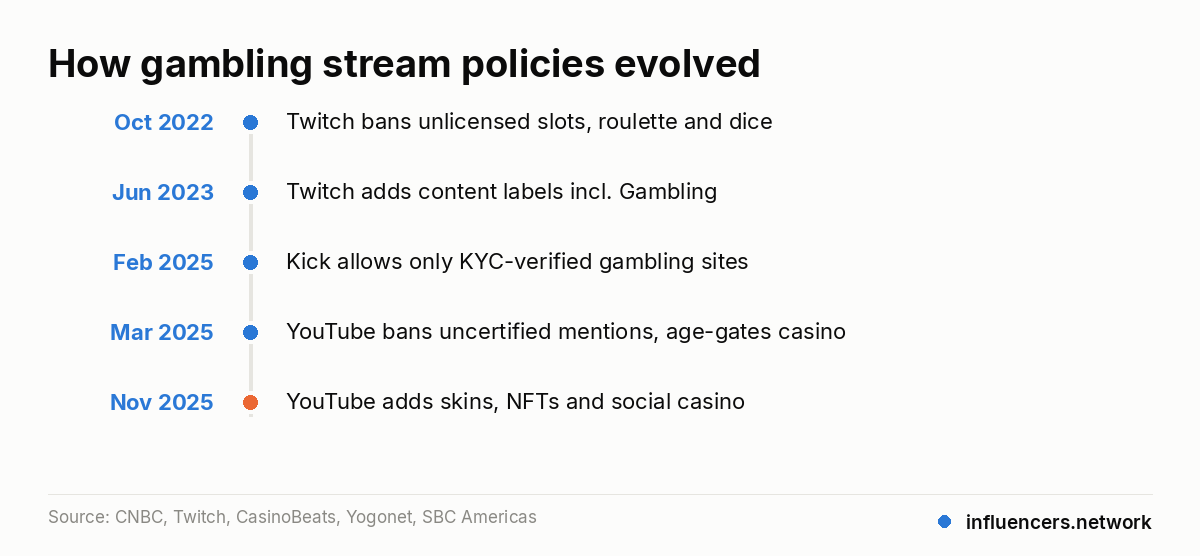
Each platform’s current rulebook is the product of a specific trigger: creator backlash at Twitch, child-safety pressure at Kick and a regulatory push around US sports betting at YouTube. Knowing the sequence helps predict where the next change will come from.
What operators and affiliates should do
Platform policy is only one of three compliance layers. The operator’s license determines where it may advertise at all. National ad rules decide what the content may look like: Ontario bars influencers likely to appeal to minors, Germany’s GGL only allows whitelisted operators to advertise, and the UK’s CAP rules ban content of strong appeal to under-18s. The platform’s policy then decides whether the stream can exist on that service.
- Match platform to product. Casino campaigns fit Kick or certified YouTube channels; sportsbook and poker campaigns can run on all three.
- Check certification and KYC before signing. Confirm the operator has Google certification in each target country for YouTube, and that its KYC flow meets Kick’s rule.
- Geo-match the audience. Ask for a country breakdown of viewers and only promote in markets where the brand is licensed.
- Write platform rules into the contract. Include no viewer buy-ins, visible disclosure, age labels and no guaranteed-return language, with a takedown clause.
- Keep responsible gambling messaging on screen. It is required in several markets and reduces platform risk everywhere.
Deal structure also changes by platform. A CPA or RevShare deal with a Kick casino streamer rarely maps one-to-one onto a Twitch sportsbook partnership; our guide to casino streamer deals covers how to structure each.
Which platform fits which campaign?
There is no single winner in the Kick vs Twitch gambling debate, because the platforms are optimized for different products. Kick offers the deepest casino audience and the most permissive rules, but brands carry more reputational and jurisdictional risk and need strong geo-controls. Twitch offers the biggest general live audience and a clean environment for sports betting and poker. YouTube offers durable, searchable video and certification-based trust, at the cost of age-gated reach for casino content.
Many operators therefore split budgets: live casino content with vetted Kick creators, sportsbook activations on Twitch around major events, and evergreen explainers or highlights on YouTube. Whatever the mix, choosing creators whose audiences are adult and located in licensed markets matters more than the platform itself.
18+ | Play responsibly. Gambling involves risk and should never be seen as a way to make money. Only work with operators licensed in the viewer’s jurisdiction. Help: BeGambleAware, NCPG (1-800-GAMBLER), JugarBien.
Frequently asked questions
Is gambling allowed on Twitch in 2026?
Partly. Since 18 October 2022 Twitch has banned streaming slots, roulette and dice from sites not licensed in the US or an equivalent jurisdiction, and prohibits links or referral codes to sites offering those games. Sports betting, fantasy sports and poker are still allowed.
Why is Kick more permissive on gambling than Twitch?
Kick treats gambling as a core category and regulates it through site eligibility rather than game type. Since 1 February 2025 streamers may only show sites that verify player identity, and sponsored gambling must be for operators licensed in the relevant jurisdiction.
Can YouTubers promote online casinos?
Only operators certified by Google may be linked, shown or mentioned. Since March 2025, online casino content is age-restricted even for certified operators, and any claim of guaranteed returns is removed.
Does following platform rules make a campaign legal?
No. Platform policies sit on top of national advertising law. A stream that is fine under Kick’s rules may still breach rules in Ontario, Germany, Spain, Brazil or the UK if the operator is not licensed there or the creator appeals to minors.
Looking for creators who already stream on the right platform for your license? Browse vetted casino, betting and esports creators in the iGaming influencer database, or list your channel for free if you’re a streamer.
Comentarios