
Most casino streamer deals are built from four pieces: a CPA paid per qualifying depositor, a RevShare on the net revenue those players generate, a hybrid of the two, or a flat fee (often a minimum guaranteed fee, or MGF) paid regardless of results. The right mix depends on how much risk each side will carry, how reliable the tracking is, and which markets the audience sits in. This guide breaks down how each casino streamer deal works, what the published benchmarks look like as of September 2026, and which clauses protect both operators and creators.
Key takeaways
- CPA pays once per qualifying player; RevShare pays a percentage of net gaming revenue (NGR) for as long as the player stays active.
- Hybrid deals (smaller CPA plus RevShare) are becoming the default structure in iGaming affiliation.
- Parimatch Affiliates cites minimum guaranteed fees of $1,000–4,000 per month for streamers with 15–20K audiences.
- Negative carryover can make a 40% RevShare earn less than a 30% one, so read that clause first.
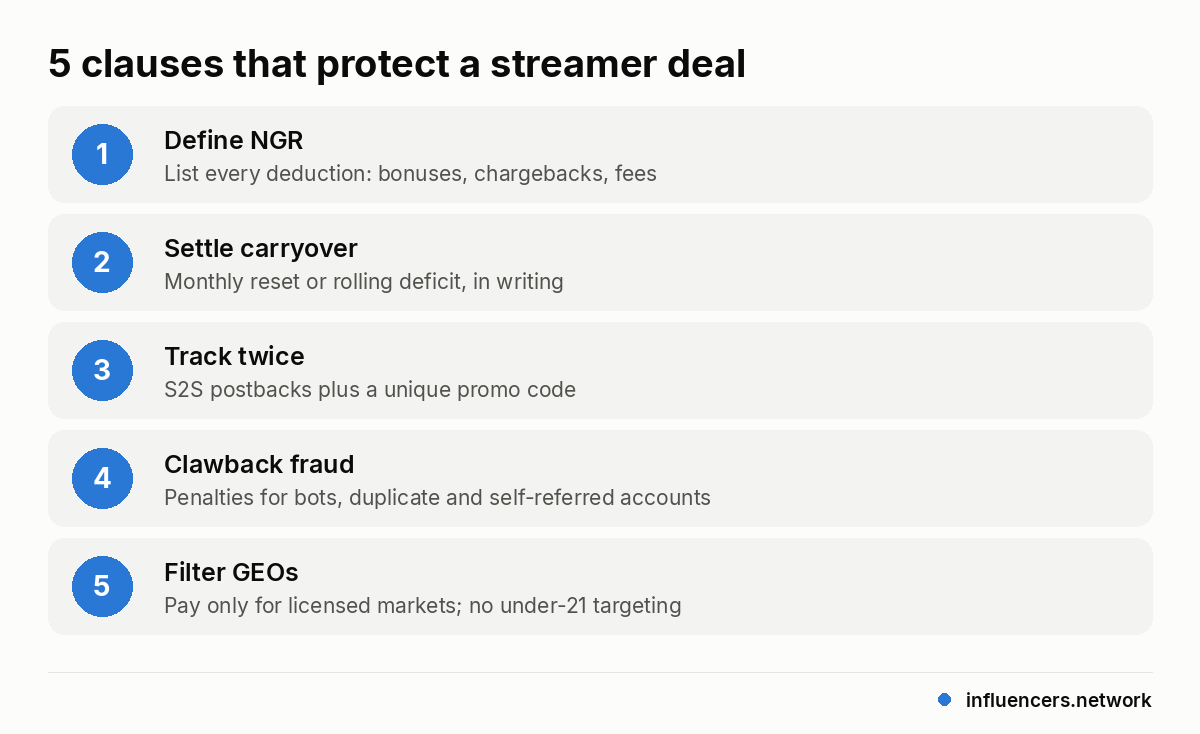
- Every structure needs S2S tracking, promo codes, fraud clawbacks and a licensed-market (GEO) filter.
Casino streamer deals at a glance: four structures
Casino streaming sits between classic affiliate marketing and sponsorship. A streamer drives registrations like an affiliate site would, but also delivers hours of branded airtime, chat mentions and on-screen overlays like a sponsored athlete. That is why casino streamer deals mix performance pay with fixed fees.
The Parimatch Affiliates 2026 guide to casino streamer partnerships lists CPA, RevShare, Hybrid, CPM (a rate per 1,000 views) and CPC (per click) as the models on offer. In practice, CPM and CPC are rare for live casino content, so most negotiations revolve around the first three plus a fixed fee.
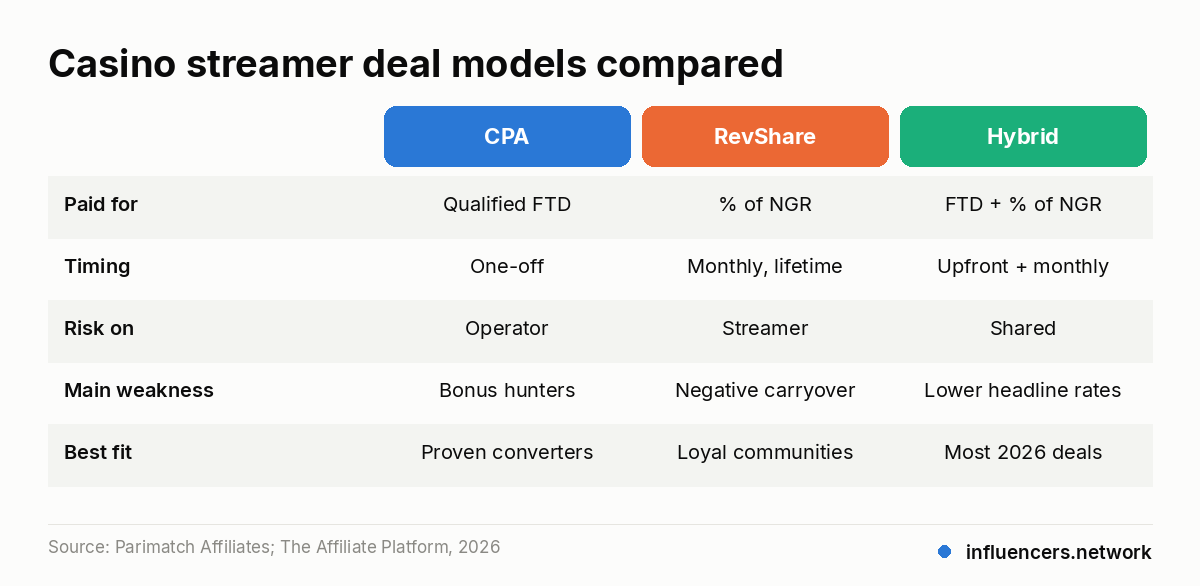
| Model | What the streamer is paid for | Who carries the risk | Best fit |
|---|---|---|---|
| CPA | Each player who meets the qualifying action (e.g. first-time deposit plus a baseline) | Operator (pays before revenue arrives) | New partnerships, proven converting audiences |
| RevShare | A % of NGR from referred players, usually monthly | Streamer (player luck and retention swing income) | Loyal, long-term communities |
| Hybrid | Lower CPA plus lower RevShare | Shared | Most streamer deals in 2026 |
| Flat fee / MGF | Airtime, overlays, scheduled streams | Operator | Established streamers with predictable reach |
| CPM / CPC | Views or clicks | Operator | Clips, VOD and short-form placements |
CPA deals: paid per qualifying depositor
Under CPA (cost per acquisition), the operator pays a one-off amount for every new customer who completes a defined action. Parimatch describes the trigger as registration or a first-time deposit (FTD); most contracts add a “baseline”, meaning a minimum deposit or wagering amount before the player counts as qualified.
CPA values depend heavily on the player’s country, because a depositor in a high-value, regulated market is worth more over their lifetime. Affiliate software provider iRev publishes the following indicative ranges. Treat them as market benchmarks, not price lists: actual offers vary by operator, vertical and traffic quality.
| Market | Indicative CPA per player | Indicative RevShare |
|---|---|---|
| United Kingdom | $200–400 | 30–45% |
| Germany | $150–300 | 25–40% |
| Canada | $150–280 | n/a |
| Brazil | $50–120 | n/a |
| Mexico | $45–110 | n/a |
The weakness of pure CPA is incentive. The streamer gets paid for volume whether or not the players stick around, which The Affiliate Platform describes as a “bonus-hunting risk”. Operators respond with baselines, caps on the number of paid CPAs per month, and clawbacks for fraudulent or duplicate accounts.
RevShare deals: a cut of net gaming revenue
RevShare pays the streamer a percentage of the revenue generated by the players they referred, usually calculated monthly and for the lifetime of the account. The key word is net. Most programs pay on NGR, which iRev defines as GGR minus bonuses, chargebacks and processing fees.
iRev’s worked example shows why that matters: $10,000 of GGR becomes $8,000 of NGR after $1,500 in bonuses, $300 in chargebacks and $200 in fees. At a 35% share, the payout is $2,800 rather than the $3,500 a streamer might expect from the headline figure.
Negative carryover: the clause that decides the deal
When referred players win more than they lose in a month, NGR goes negative. With negative carryover, that deficit rolls into the next month and must be recovered before the streamer earns again. According to Scaleo’s 2026 RevShare benchmarks, 52% of programs tracked on its platform apply negative carryover, and “a 40% deal with negative carryover can earn less than a 30% deal without it.”
For casino streamers this is not theoretical. A community that follows a streamer’s play can hit a lucky streak together, creating a deficit that erases several months of commission. Ask whether the balance resets monthly (no negative carryover, often shortened to NNCO) or carries over indefinitely.
Hybrid deals: why they are becoming the default
A hybrid combines a smaller upfront CPA with an ongoing, smaller RevShare. Parimatch Affiliates calls it “the safest option, as CPA covers the start of the partnership and RevShare works during the retention period.” The Affiliate Platform’s 2026 market review also identifies hybrid commission as the emerging standard.
iRev illustrates the trade-off with a hybrid of $60 CPA plus 20% RevShare, set against alternatives of $120 CPA only or 35% RevShare only. The streamer gives up part of each component in exchange for cash flow on day one and upside if players stay.
Scaleo’s illustration shows how large the long-tail difference can be. For 100 referred players averaging $120 of monthly NGR, a 35% RevShare would total $50,400 over a year, versus $12,000 from a flat $120 CPA. That example assumes every player stays active for 12 months, which rarely happens, so model churn before choosing.
Flat fees and minimum guaranteed fees (MGF)
Established streamers usually expect some pay that does not depend on conversions, because a scheduled stream consumes hours of airtime whatever the result. That takes two forms: a straight sponsorship fee (per stream, per month or per campaign) or an MGF that acts as a floor against commission.
Parimatch Affiliates gives a concrete range: an MGF of $1,000–4,000 per month for streamers with a 15–20K audience. It also advises operators to put at least 20–30% of the budget on RevShare “to protect against possible losses”, so that a guaranteed fee is always paired with a performance element.
Check how the MGF interacts with commission. In some contracts the MGF is deducted from commission earned (a true floor); in others it is paid on top. The difference can double the effective cost for the operator, so it must be written out explicitly.
Fixed fees are also where general influencer pricing benchmarks help. Our influencer marketing statistics for 2026 show that rising creator costs are the top challenge for 35.4% of brands, which explains why operators push to convert flat fees into guarantees against performance.
Tracking, payouts and fraud protection
No deal structure works without reliable attribution. Live streams create messy journeys: viewers watch on a TV, sign up on a phone and deposit days later. Server-to-server (S2S) postback tracking, which The Affiliate Platform calls standard in 2026, survives those cross-device journeys better than cookies. Promo codes add a second, human-readable signal.
Parimatch lists the red flags operators should watch in streamer traffic:
- Many visits without deposits, a sign the audience does not convert.
- Most traffic coming from a handful of IP addresses or devices, a bot indicator.
- Low chat activity relative to the viewer count.
- A sharp drop in views right after a peak, suggesting inflated numbers.
Standard protective terms in the same guide include penalties and clawbacks for bot traffic and fraud, a $100 minimum payout threshold, 30 days’ notice for termination and a 15-day cure period for material breach. Viewer data from our gambling streaming statistics can help set realistic benchmarks for average viewers before you sign.
Compliance terms every casino streamer deal needs
The commercial model is only half of any casino streamer deal. The other half decides whether the deal can legally run at all, and it varies by platform and country.
- Platform rules. Twitch has prohibited streaming slots, roulette and dice sites not licensed in the US or other jurisdictions with sufficient consumer protection since 18 October 2022. Kick has only allowed gambling streams of approved sites with identity verification since 1 February 2025, as reported by Dexerto.
- Licensed markets only. Add GEO filters so traffic from markets where the operator is not licensed is neither paid nor targeted. In Germany only GGL-whitelisted operators may advertise.
- Influencer-specific bans. Ontario’s AGCO standards bar social media influencers likely to appeal to minors from igaming ads, and Brazil’s Senate committee approved Bill 2.470/2026 on 3 September 2026, which would further restrict influencer promotion if it becomes law.
- Age and RG terms. Parimatch’s template prohibits targeting anyone under 21 and requires GDPR and AML compliance. Add disclosure (#ad) and responsible-gambling messaging on every stream.
A contract that pays well but ignores these points exposes both parties to account bans, regulatory fines and clawed-back commission.
How to choose the right structure
For operators and affiliate managers, a practical rule is to match fixed pay to what you can verify. If you can verify viewers and chat engagement but not conversions yet, start with a small MGF plus hybrid commission and review after 60–90 days. If the streamer already has a tracked conversion history, lean on CPA or hybrid with a lower or no guarantee.
For streamers, the decision rests on community loyalty. A stable community that returns weekly makes RevShare more valuable over time; a fast-growing, transient audience favors CPA. Either way, negotiate the NGR definition, negative carryover and clawback windows before the headline percentage.
This short explainer walks through common gambling affiliate program terms, including commission models, that come up in streamer negotiations.
18+ | Play responsibly. Gambling involves risk and should never be seen as a way to make money. Only work with operators licensed in the viewer’s jurisdiction. Help: BeGambleAware, NCPG (1-800-GAMBLER), JugarBien.
Frequently asked questions
What are the most common casino streamer deals in 2026?
Hybrid deals, combining a smaller CPA with an ongoing RevShare, are increasingly the default according to The Affiliate Platform and Parimatch Affiliates. Larger streamers often add a monthly minimum guaranteed fee.
What RevShare percentage do casino affiliates typically get?
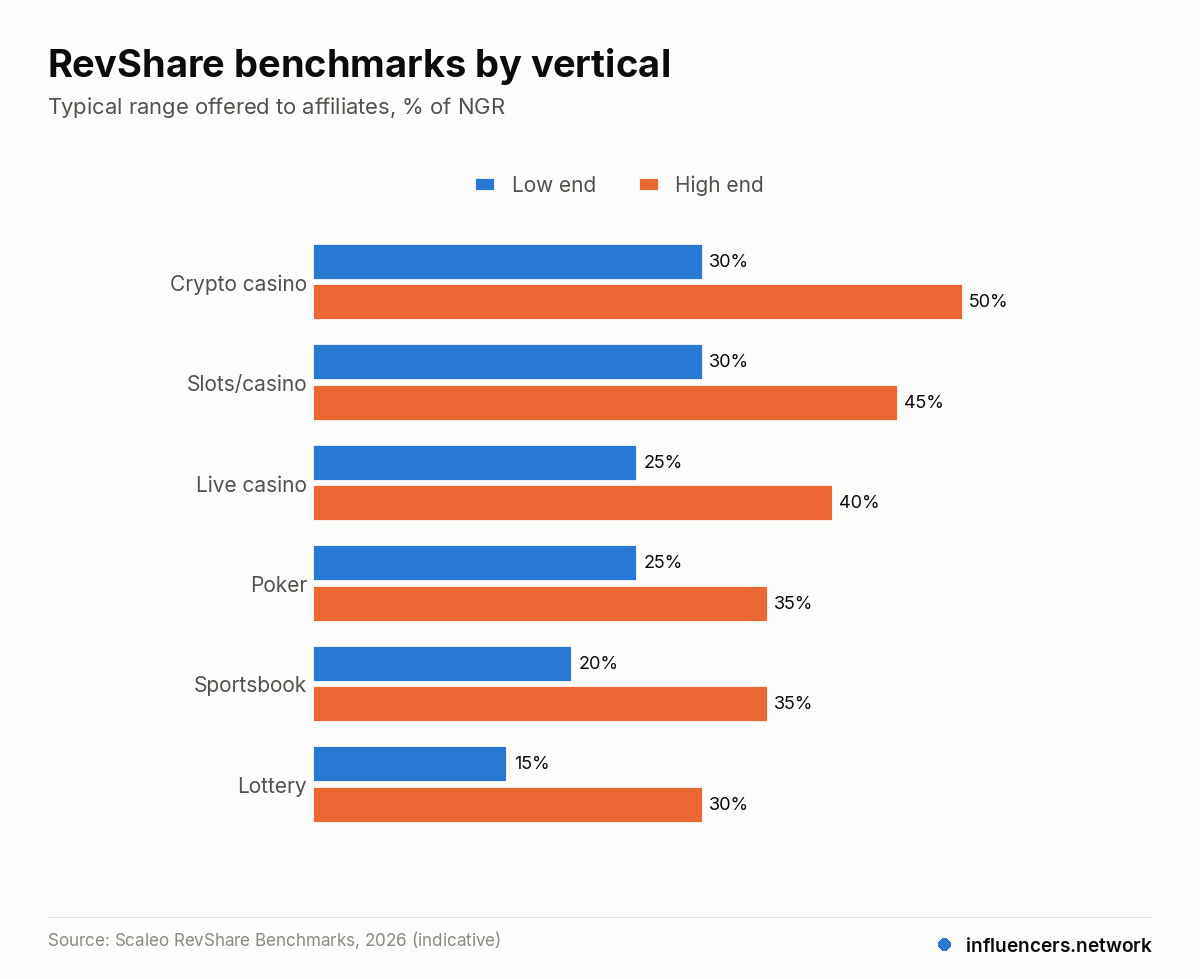
Scaleo’s 2026 benchmarks put slots and casino RevShare at 30–45%, with entry-level deals around 25–30% and top-tier partners at 40–50%. These are indicative ranges; the NGR definition and negative carryover matter as much as the percentage.
What is a minimum guaranteed fee (MGF)?
An MGF is a fixed monthly payment that guarantees the streamer a minimum income regardless of conversions. Parimatch Affiliates cites $1,000–4,000 per month for streamers with 15–20K audiences.
Can a streamer promote any casino on Kick or Twitch?
No. Twitch bans slots, roulette and dice sites not licensed in the US or similarly protective jurisdictions, and Kick only permits approved sites with KYC. Operators must also hold a license in each viewer’s market.
Looking for streamers whose audience and GEOs fit your deal structure? Browse the iGaming influencer database, or read our influencer marketing guide for the wider campaign playbook.
Comments